Cart
0






Buying a hookah can look simple until you start comparing them.
One is 11 inches tall. Another is twice the size. Some have glass bases, others use metal or acrylic. One comes apart into several pieces while another feels almost like a single unit. Then there are bowls, stems, hoses, seals and valves to think about.
That is why choosing a hookah machine only by appearance or height is rarely a good idea.
A better approach is to understand the basic parts, decide what size fits your space and check whether the entire system is properly built and easy to maintain.
This guide explains exactly that without turning a fairly simple product into an engineering degree.
"Hookah machine" is a common search term in India for what is more accurately called a hookah, hookah pipe or hookah set.
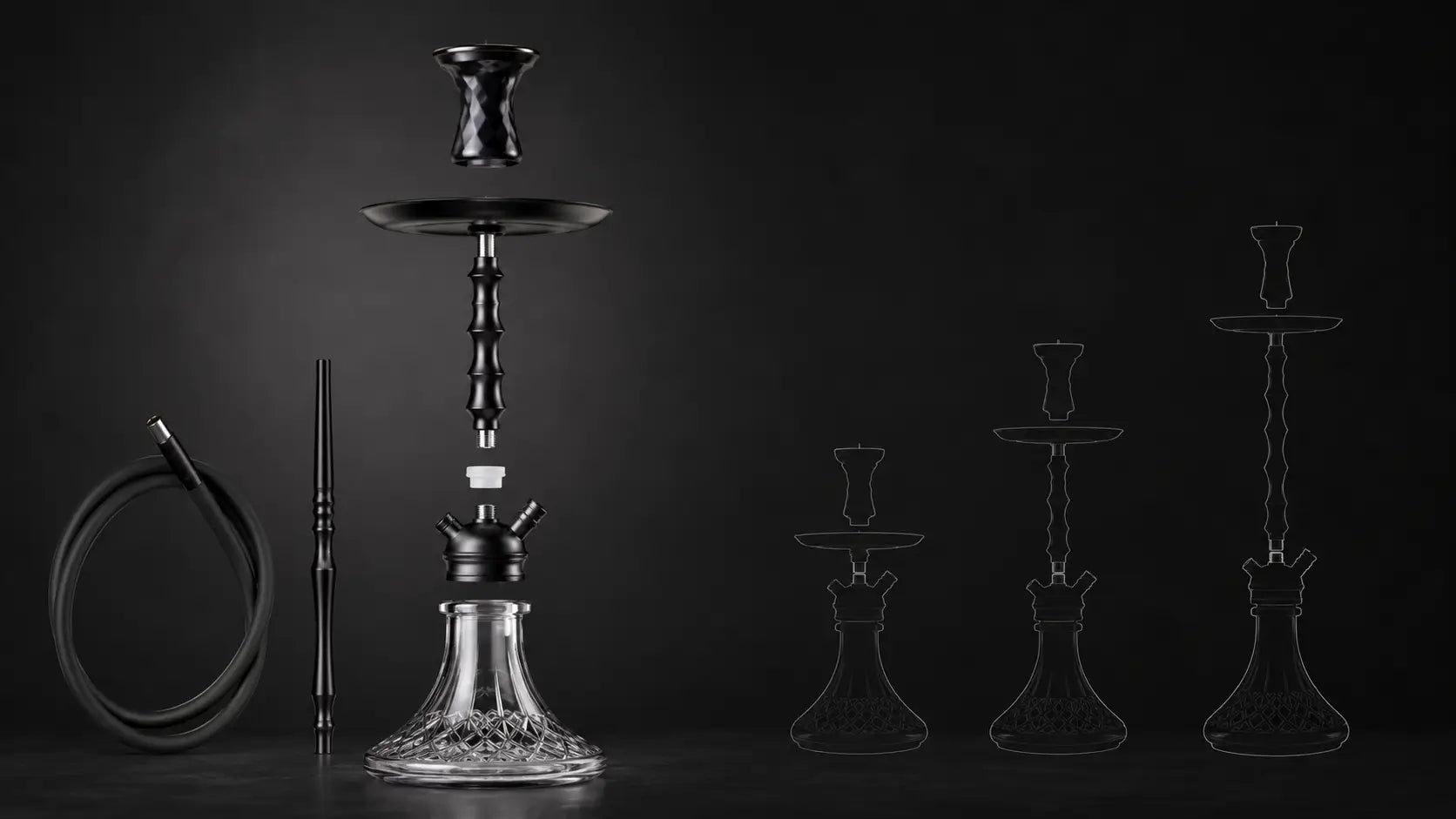
A traditional hookah is a water-pipe system made from several connected components. The basic structure normally includes a bowl at the top, a central stem, a water base and a hose with a mouthpiece.
These parts need to work together as one properly sealed system. That is why build quality and fit matter just as much as how the hookah looks.
If you are comparing different materials such as glass, acrylic and metal, LIT already has a separate Glass vs Acrylic vs Metal Hookah Guide. This article focuses instead on size, parts and the practical things to inspect before buying.
You do not need to memorise twenty technical terms before buying a hookah. Understanding the main components is enough to spot major differences between two models.
The bowl sits at the top of the hookah.
Hookah bowls can be made from clay, ceramic, stoneware and other heat-resistant materials. When comparing them, check that the bowl sits securely on the hookah rather than wobbling or leaning noticeably to one side.
A removable bowl is also easier to inspect, clean and replace if required.
The tray sits underneath the bowl area.
Its main practical role is to provide a surface around the upper section of the hookah and help keep the setup organised.
Check whether the tray sits firmly and whether it can be removed easily for cleaning.
The stem is the central vertical part of the hookah.
It connects the upper assembly with the base below. Part of the stem extends downward into the base and is often referred to as the downstem.
This is one of the areas where build quality matters. The stem should feel securely fitted rather than loose or poorly aligned.
The base is the lower chamber of the hookah and usually holds water during use.
Bases are commonly made from glass, acrylic or other durable materials.
From a buying perspective, look at more than the material. Check:
whether the bottom is stable;
whether the base feels proportionate to the hookah height;
whether it connects securely to the stem;
whether the opening is easy to access for cleaning; and
whether replacement would be possible if the base were ever damaged.
A beautiful hookah with an unstable base is mostly a beautiful accident waiting to happen.
Some of the smallest parts of a hookah can cause the biggest problems.
Rubber or silicone gaskets are commonly used around connection points such as the base, bowl and hose.
Their job is simple: create a secure fit between components.
Before buying, check that connection points sit firmly together. Loose-fitting components can indicate worn, incorrectly sized or poorly fitted seals.
The hose connects to the hookah body and ends in a mouthpiece.
Check:
hose length;
flexibility;
quality of the outer material;
condition of the connectors;
whether the mouthpiece feels secure; and
whether the hose can be removed for cleaning or replacement.
A long hose can provide more freedom of movement around a table, while a shorter hose may be easier to store.
The mouthpiece is the part attached to the end of the hose.
Look for a smooth, comfortable construction with no rough edges or loose fittings.
For hygiene, removable and cleanable components are particularly useful, especially where equipment may be shared.
Many modern hookahs include a purge valve on the main body.
It is a small one-way valve incorporated into the hookah's airflow system. From a maintenance perspective, it should move freely and should not appear jammed, damaged or badly fitted.
Hookah dimensions vary widely, but they can broadly be thought of as compact, medium and tall formats.
There is no official universal rule defining the exact boundary between each category, so treat the following as a practical buying framework rather than an industry standard.
|
Hookah Size |
Approximate Height |
Best Suited To |
Main Consideration |
|
Compact / Mini |
Under about 15 inches |
Small spaces, easier storage and portability |
Smaller overall footprint |
|
Medium |
About 15–24 inches |
Home setups where portability still matters |
Requires more storage space |
|
Tall |
Above about 24 inches |
Permanent home or display-oriented setups |
Least convenient to carry and store |
A compact hookah makes sense when space and portability are priorities.
It can be easier to:
store inside a cabinet;
move between rooms;
fit onto smaller tables;
pack away after use; and
transport compared with a large traditional hookah.
Compact does not automatically mean cheap or poorly built. Size and construction quality are two separate things.
For example, the Lit Ember Premium Glass Hookah stands approximately 11 inches tall and weighs around 2.1 lbs, putting it firmly in the compact category despite using a glass base and detachable multi-part construction.
A medium hookah can be a practical choice if it will mostly stay at home but you do not want a very large setup.
The larger footprint may provide more room for the base, stem and other components while still being manageable enough to move or store when required.
Before choosing one based purely on height, check its actual base dimensions and total weight. Two hookahs of the same height can feel completely different to handle.
Tall hookahs have a strong visual presence and can suit buyers who want a more permanent setup.
But height brings practical compromises.
A taller hookah can require:
more storage space;
a larger stable surface;
more careful handling;
more room during cleaning; and
less convenient transportation.
Do not assume a 30-inch hookah is automatically superior to an 11-inch one.
The better size is the one that works in the place where you will actually keep it.
Start at the bottom.
A hookah should sit confidently on a flat surface. Look at the width and shape of the base and consider whether it feels stable in proportion to the overall height.
This becomes especially important with taller hookahs.
The main body should connect securely to the base.
Check the gasket and connection mechanism. There should not be obvious looseness between the two sections.
The bowl should sit securely on its fitting.
If the bowl constantly tilts or feels unstable, the problem may be the bowl itself, the gasket or compatibility between the components.
Glass, metal and acrylic all have different advantages and compromises.
Rather than declaring one material universally best, consider durability, cleaning, weight, appearance and where the hookah will be kept.
For a detailed material comparison, read our guide to glass, acrylic and metal hookahs.
This is easy to overlook in product photographs.
A hookah made from detachable components can be easier to:
clean thoroughly;
store;
transport;
inspect for wear; and
repair by replacing individual components.
Check how many pieces are removable before buying.
A hose should be flexible enough to move comfortably without constantly pulling against the hookah body.
Also check whether the hose and mouthpiece can be cleaned or replaced.
If you have a small table, an unnecessarily long hose may simply spend most of its life on the floor. Length is useful only when you need it.
Most personal setups only need one hose.
Some hookahs, however, support more than one hose connection. This may matter if multiple-hose compatibility is specifically important to you.
Do not pay extra for additional ports simply because the feature sounds impressive. Buy according to how the equipment will actually be used.
Ask one boring question before buying:
What happens if one part breaks?
A replaceable hose, bowl or gasket can save you from replacing an otherwise perfectly usable hookah.
Detachable construction therefore has value beyond cleaning—it can make maintenance much simpler over time.
The Lit Ember Premium Glass Hookah is a useful example of what to look for in a compact design.
Its current specifications include:
Total height: approximately 11 inches
Weight: approximately 2.1 lbs
Glass base: 5.5 inches
Stem: approximately 5 inches
Hose: approximately 62 inches
Bowl: glazed stoneware
Base: solid glass
Hose: leather with stainless-steel casing
Handle: wood
Construction: detachable five-piece design
Hose capability: supports up to two hoses
The important point is not that every hookah should have exactly these specifications.
It is that specifications tell you considerably more than a product photograph.
Look at dimensions, materials, detachable parts and hose configuration before deciding whether a hookah fits your needs.
One of the easiest buying mistakes is treating size as a quality rating.
A large hookah can still have poor fittings, weak seals or inconvenient construction.
A compact hookah can still use a solid glass base, good-quality bowl and replaceable components.
Judge size according to:
your available space;
how often you need to move it;
where it will be stored;
overall stability; and
how easily it can be cleaned.
Judge quality separately by looking at materials, fit and construction.
The main parts generally include the bowl, tray, stem and downstem, base, gaskets, hose, mouthpiece and, on many modern models, a purge valve.
A compact hookah under roughly 15 inches can be easier to store and use in a limited space. Check the base width as well as the height because both affect how much room the hookah actually needs.
No. A larger hookah takes up more space and can be harder to move, clean and store. Construction quality, seals, materials and stability are more useful buying criteria than height alone.
Check the full dimensions, weight, base material, bowl material, hose length, number of detachable components, gasket design, hose configuration and whether important parts can be replaced.
They serve different preferences. Glass can provide a clean, modern appearance and makes the contents of the base visible, while metal is often chosen for durability. Read our Glass vs Acrylic vs Metal Hookah comparison for a more detailed breakdown.
Hookah prices vary widely depending on size, material, brand, construction and included components. As one current example, the Lit Ember Premium Glass Hookah is listed at ₹1,200. Always check the live product page for current pricing before buying.
Yes. An 11-inch model would generally fall into the compact or mini-hookah category and may suit users who prioritise easier storage and portability.
Choosing the right hookah becomes much easier once you stop judging everything by height and appearance.
Start with the practical questions:
Will it fit comfortably in your space?
Is the base stable?
Do the parts connect securely?
Can it be taken apart and cleaned easily?
Is the hose suitable for your setup?
Can individual parts be replaced?
A compact hookah can be the smarter choice for a smaller room or easier storage. A larger model may suit a permanent home setup. Neither is automatically better.
The best hookah machine is simply the one whose size, construction and components make sense for how and where you plan to keep it.
If a compact setup fits your requirements, you can view the specifications of the Lit Ember Premium Glass Hookah or read our existing Hookah Material Buying Guide before comparing options.
Health note: Hookah smoking is not a safe alternative to cigarette smoking. Hookah smoke can contain nicotine and other harmful substances, and passing smoke through water does not remove these risks. This article is intended for adults of legal smoking age and is provided for product-information purposes only.