Cart
0





A story about 12,000 years of human ritual, a brain receptor that was always waiting, and why the best smoke you'll ever have is the one you roll yourself.
By the time you finish reading this, you'll never look at a factory cigarette the same way again. Not because of what's in it. But because of what's been taken out.
In 2021, archaeologists excavating a fire hearth in Utah's desert found something that rewrote history: tobacco seeds, preserved in ash, dated to approximately 12,300 years ago. This pushed the documented history of human tobacco use back by nine thousand years to a time when the first humans to reach the Americas were still mapping coastlines, still learning what the land had to offer.
And yet, almost immediately, they found tobacco. And they brought it to the fire.
This wasn't an isolated instinct. On the Pamir Plateau of western China, burial sites dated around 500 BCE contained wooden braziers beside human graves filled with cannabis residue at THC levels far above anything that grows naturally in the region. Someone had been carefully selecting these plants for their effect. And burning them at the moments that mattered most: at funerals, at thresholds, at the edges between the ordinary world and whatever lay beyond it.
Two finds. Two continents. Thousands of years apart. The same structural truth underneath both of them.
Burning a plant, deliberately, was never casual. It was always intentional.
The question worth asking is: when did we stop being intentional about it?
The human brain contains receptors called nicotinic acetylcholine receptors structures that evolved millions of years before tobacco existed, designed to bind acetylcholine, the neurotransmitter involved in attention, focus, and arousal. Nicotine, the alkaloid in tobacco, fits into the exact same binding site. The plant's chemistry wears a disguise your brain cannot see through.
When nicotine binds to these receptors in the brain's reward hub, it triggers a cascade that releases dopamine the same pathway activated by food, by connection, by things that matter. The brain's message, translated simply: that was significant. Remember this. Do it again.
But here's what the cigarette industry quietly built its entire business model around.
Nicotine inhaled through the lungs reaches the brain in seven to ten seconds. Faster than an intravenous injection of most other substances. And the brain's reward system works by association: whatever behaviour immediately preceded the dopamine hit gets tagged as the cause. The faster the delivery, the stronger the tag.
Which means every component of the smoking ritual the preparation, the lighting, the first draw becomes neurologically meaningful in its own right. The ritual isn't just delivering the experience. The ritual is part of the experience.
The factory cigarette understood this perfectly. Pre-packaged, pre-rolled, pre-measured it collapsed the ritual down to zero preparation time. Light up and get the hit. Maximum efficiency. Maximum dependency. Minimum intention.
What got lost in that efficiency was everything that made the ritual matter.
Ask a smoker why they stepped outside and they'll say: I needed a break.
Ask them why they needed a cigarette to take one and they'll pause.
The cigarette doesn't give you the break. It gives you permission to take it. It's a culturally recognised prop, the one object that makes stepping away from a meeting, a screen, a conversation, completely legible to everyone around you. Without it, standing outside breathing for five minutes is eccentric. With it, it's understood.
This is the function of the smoke break that no nicotine patch, no gum, no spray has ever successfully replaced and it's not pharmacological. It's structural. It's about time.
Brain imaging studies confirm this. The beginning and end of the smoking ritual activate different neural regions, anticipation and completion are encoded as distinct experiences. The brain doesn't register "smoking" as a single event. It registers a beginning, a middle, and an end. A story with three acts.
A factory cigarette gives you Acts 2 and 3. You open a pack. You light it. You smoke it.
Rolling gives you all three including the part that matters most.
In 1909, the French ethnographer Arnold van Gennep published a study of ritual structures across human cultures. His finding was simple and universal: every significant ritual, coming-of-age ceremonies, funerals, harvests, initiations followed the same three-phase structure.
Separation. You leave ordinary time and space. Liminality. You enter a threshold, a space where normal rules are suspended. Incorporation. You return, changed, having marked a moment as different from all others.
The shaman who stepped out of the village to commune with the spirits in smoke was using this structure. The mourners on the Pamir Plateau, 2,500 years ago, with their braziers of burning plants, were using this structure. And the smoke break — stripped of its mysticism but structurally identical uses this structure every single day.
You step outside. Separation. You stand in the threshold between the building and the street, between this moment and the next. Liminality. You return, slightly reset, the moment marked. Incorporation.
Now here's the question: which version of this ritual is more complete?
The factory cigarette collapses the separation phase to nothing. You reach into your pocket, produce a ready object, and light it. The threshold is brief. The return is abrupt.
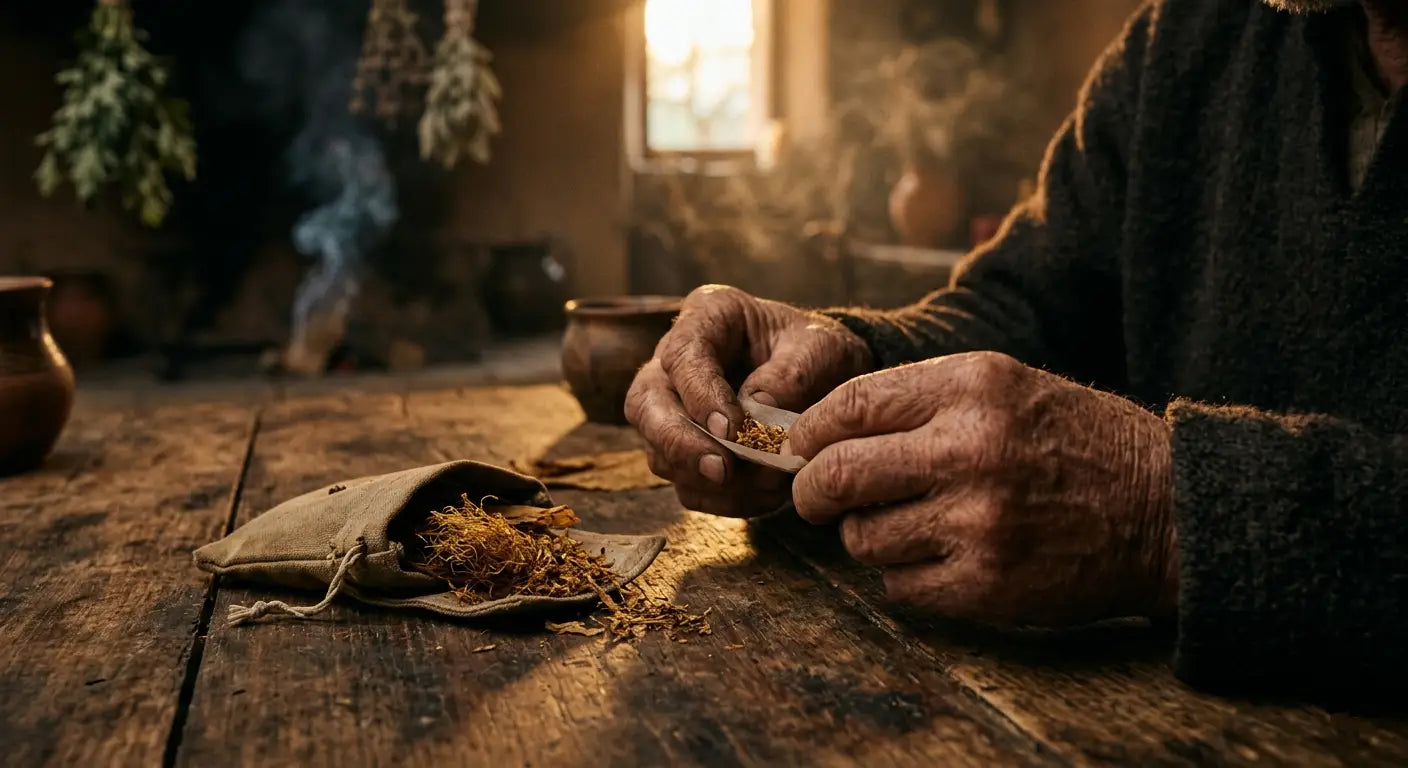
Rolling extends the separation deliberately. You reach for your pouch. You feel the tobacco between your fingers its particular resistance, its warmth. You prepare the paper. You roll, slowly, with the attention your hands have learned to give this. By the time you light it, you have already fully left ordinary time.
The roll is not preparation for the ritual. The roll is where the ritual begins.
Van Gennep would have recognised it immediately: a rite of passage, miniaturised and made portable. But only if you don't skip the first act.
India is the second-largest producer of tobacco in the world. The Andhra Pradesh and Karnataka valleys grow some of the finest Virginia leaf on the planet. Long before the factory cigarette arrived, India had one of the richest tobacco cultures on earth bidis rolled by hand, hookah shared between friends, chillums with histories older than most cities.
And yet, for the better part of a century, the modern urban Indian smoker has been reaching for a product designed in boardrooms in London and Richmond, Virginia. One that treats Indian tobacco as raw material and sells it back to Indian smokers at a markup stripped of everything that made it interesting.
What the factory did, everywhere but especially here, was take a tobacco leaf that is ancient, complex, and shaped by soil and climate and careful curing and engineer it into a delivery mechanism. Burn accelerants to keep it lit between puffs. Humectants to survive months of shelf storage. Flavour compounds to smooth over a tobacco that was never meant to taste like this. The goal was not your experience. The goal was consistency, shelf life, and an optimised nicotine delivery curve designed to ensure you'd need another one in forty minutes.
There is a moment if you've rolled before, you know the one when the tobacco is in the paper, your fingers have found their tension, and everything is aligned just before you seal it.
Your hands know something your conscious mind doesn't. The paper has a particular give. The tobacco has a density your fingers have calibrated to without you noticing. Nothing rushed. Nothing digital.
When you open a pouch of properly cured Virginia tobacco fine-cut, barn-cured, moisture-preserved the smell arrives before anything else. Not the synthetic sweetness of a pack of cigarettes. Something older. Warm and faintly woody, the way a curing barn smells in autumn, the way the leaf smells when it's just been harvested and hasn't been touched yet by anyone who wants to change it.
The roll you make from it burns evenly not because a machine calibrated it, but because you did. The first draw lands differently than anything the factory produces. Not engineered smooth. Actually smooth. The two are not the same thing, and anyone who's smoked both knows it immediately.
This is what the factory replaced. This is what you get back when you roll.
For most Indian smokers who've explored rolling, the options have historically been imported: Drum from the Netherlands, Pueblo from Austria, American Spirit from the US sold at a premium, shipped from the other side of the world, often dry by the time they reach you. Fine products, but products designed for someone else's market, grown somewhere else, priced accordingly.
LIT Masala was built as the answer to that gap.
Made from 100% natural Virginia tobacco sourced from the same valleys that have been producing world-class leaf for generations LIT Masala Premium RYO is barn-cured using century-old processing methods, fine-cut for effortless rolling, and packed in an airtight pouch that preserves moisture, aroma, and texture from production to your hands.
No additives. No mystery. No engineering for dependency.
One customer, comparing it against the imported standards, put it plainly: "A million times better than the usual RYO tobacco you find in the market - at half the price."
That's not marketing language. Those are the words of someone who has smoked both and made a judgment. At ₹660 for 40g, available on Blinkit, Zepto, and Instamart for delivery in under ten minutes the choice to roll rather than reach for a pack has never been easier to act on.
In every tobacco culture that predates industrialisation from the ceremonial pipes of the Americas to the communal hookah sessions of the Middle East to the hand-rolled bidis of rural India tobacco was prepared in company. You watched someone roll. They taught you. You shared the result. The preparation was part of the social act.
The pre-rolled cigarette made that invisible. You bought a product. You consumed it. There was nothing to share in the making.
Rolling brings it back. The community that has grown around LIT is, in that sense, continuous with much older people who share not just a product but a practice. Who knows the difference between a well-rolled smoke and a factory-pressed one. Who've made something with their hands and found it better for that reason.
This is not nostalgia.
It's the original thing.
For adult tobacco consumers only. Tobacco is injurious to health.